
The Event That Changed the City Forever
When visitors walk through Parc de la Ciutadella today, admire the Arc de Triomf, or enjoy Barcelona’s elegant boulevards, few realize that many of these places owe their existence to a single event.
The 1888 Barcelona World Fair wasn’t just an exhibition.
It was a turning point.
A moment when Barcelona decided to present itself to the world as a modern, ambitious, international city.
What’s surprising is that the event almost never happened.
Barcelona Before the World Fair
In the 1880s, Barcelona was growing fast but facing serious challenges.
The city was dealing with economic difficulties, industrial uncertainty, and the effects of the phylloxera plague that had devastated vineyards across Catalonia. Unemployment was high, public finances were strained, and many questioned whether Barcelona could afford such an ambitious project.
Yet at the same time, Barcelona was becoming one of Spain’s most dynamic industrial centres.
Railway connections were expanding, factories were transforming the economy, and a new generation of entrepreneurs believed the city could compete with Europe’s great capitals.
The idea of hosting a World Fair emerged from that ambition.
A Project on the Verge of Collapse
What many people don’t know is that the World Fair began as a private initiative.
The original promoter, Eugenio Serrano de Casanova, envisioned a grand international exhibition that would place Barcelona on the global map.
There was only one problem.
The project quickly ran out of money.
Construction advanced slowly. Some of the first structures were built with recycled materials from other exhibitions. Municipal inspectors criticized the quality of the work, deadlines slipped, and confidence evaporated.
By 1887, the entire project was in danger of collapsing.
At one point, cancelling the exhibition was a very real possibility.
Today we remember the World Fair as a triumph.
At the time, many people thought it would become a disaster.
The City Steps In
Everything changed when Barcelona’s city government took control.
Mayor Francesc de Paula Rius i Taulet and a group of influential businessmen and industrialists reorganized the project and effectively restarted the exhibition with only a few months remaining before the opening date.
The challenge was enormous.
Entire sections had to be redesigned, infrastructure had to be completed, and the city had to prepare for visitors arriving from across Spain, Europe, and beyond.
Against all expectations, they succeeded.
On 20 May 1888, the Barcelona World Fair officially opened its doors.
What Did Visitors Actually Experience?
One of the most fascinating descriptions comes from contemporary newspaper reports.
A journalist visiting the exhibition shortly after its opening described an overwhelming experience.
The exhibition was so vast that attempting to see everything in a single day was almost impossible.
Visitors wandered through enormous halls filled with machinery, artworks, industrial inventions, exotic products, scientific displays, and exhibits from around the world.
The journalist joked that after several hours of walking, visitors became exhausted, their feet hurt, and their minds struggled to process everything they had seen.
In some ways, the experience sounds surprisingly modern.
Anyone who has tried to fit the Sagrada Família, Park Güell, the Gothic Quarter, and Barceloneta into one day might understand the feeling.
The World Fair wasn’t simply an exhibition.
It was a spectacle.
Barcelona Almost Built Its Own Eiffel Tower
The timing of the exhibition created an unexpected challenge.
While Barcelona was preparing its World Fair, Paris was preparing its own exhibition for 1889 and had already begun construction of what would become the Eiffel Tower.
Inspired by the French project, several proposals emerged for monumental towers in Barcelona.
One design by the French engineer Lapierre envisioned a giant wooden structure around 200 metres tall.
Another proposal by architect Pere Falqués imagined an enormous iron-and-stone tower that may have stood near today’s Plaça Tetuan.
Neither project was ever built.
The costs were considered excessive, and the city focused on completing the exhibition itself.
But for a brief moment, Barcelona almost had its own answer to the Eiffel Tower.
👉 Read more: The Towers Barcelona Never Built
The Hotel That Vanished

If the Arc de Triomf became the lasting symbol of the 1888 World Fair, the Hotel Internacional became its greatest disappearing act.
Barcelona expected thousands of visitors from around the world and needed accommodation on a scale the city had never seen before.
The solution was extraordinary.
Architect Lluís Domènech i Montaner designed a huge hotel near the waterfront, built at astonishing speed specifically for the exhibition.
For a few months, it was one of the most impressive buildings in Barcelona.
Then, when the World Fair ended, it was demolished.
Gone.
Today, almost nobody remembers it existed.
Yet for a brief moment, the Hotel Internacional embodied everything the Expo represented: ambition, urgency, innovation, and the desire to impress the world.
👉 Read more: The Hotel Barcelona Built in Record Time and Then Destroyed
The Fair That Reshaped Barcelona
Although many exhibition buildings disappeared after 1888, the fair permanently transformed the city.
The neglected military grounds of the old Citadel became the Parc de la Ciutadella we know today.
The Arc de Triomf became the ceremonial gateway to the exhibition and remains one of Barcelona’s most recognizable landmarks.
Roads, public spaces, transport links, and urban infrastructure were improved to welcome visitors from around the world.
The exhibition also accelerated the cultural confidence that would later help shape Modernisme and the Barcelona of Gaudí’s era.
Many of the ideas that defined the city during the following decades can be traced back to the atmosphere created by the World Fair.
👉 Read more: How the 1888 Expo Helped Create Modern Barcelona
Arc de Triomf: The Gateway to a New Barcelona
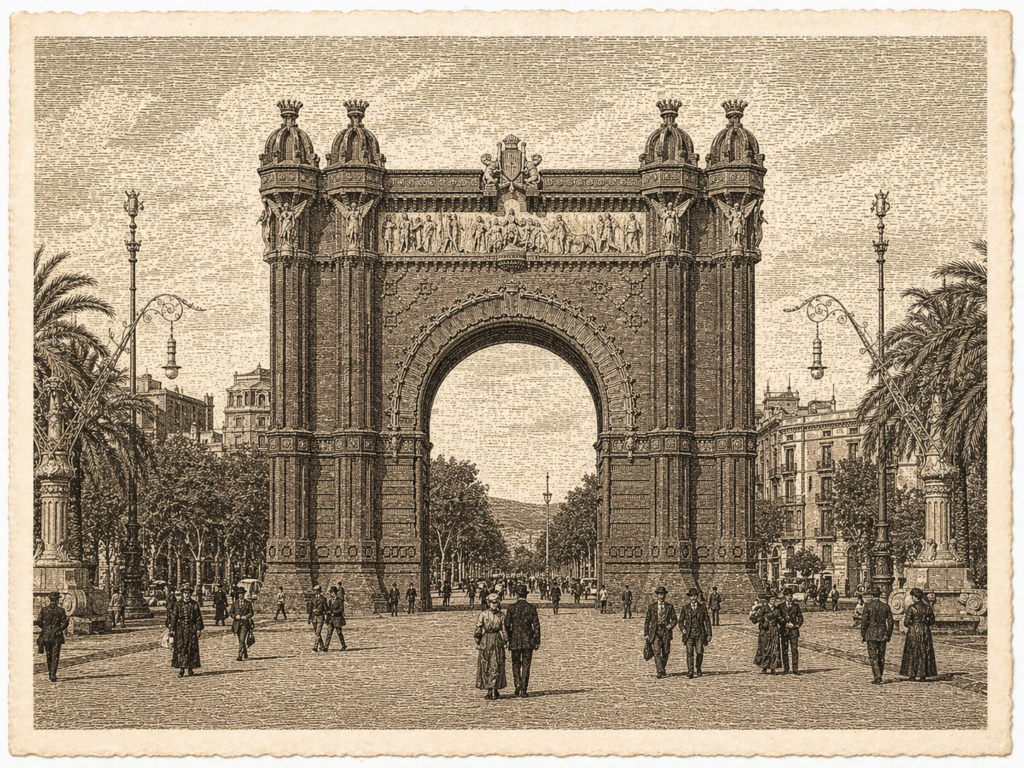
Today, Arc de Triomf is one of Barcelona’s most photographed landmarks.
Many visitors assume it commemorates a military victory, like other triumphal arches around Europe.
In fact, it was built for a very different purpose.
The Arc served as the main entrance to the 1888 World Fair, welcoming visitors arriving at the exhibition grounds in Ciutadella Park.
Designed by architect Josep Vilaseca i Casanovas, it was intended to send a message from the very first moment:
Barcelona was modern, ambitious and open to the world.
Unlike many triumphal arches, this one celebrated progress, industry, culture and international exchange rather than military conquest.
More than 130 years later, it still performs the same role.
Every day, thousands of locals and visitors walk beneath it without realizing they are passing through the symbolic gateway to the event that helped shape modern Barcelona.
👉 Read more: Why Was Arc de Triomf Built?
Hidden Traces of the 1888 Spirit Across Barcelona
The legacy of the 1888 Universal Exposition didn’t end when the event closed — it became embedded in the city’s architecture and identity.
Across Barcelona, you can still find subtle details that reflect this moment of transformation, when the city embraced progress, industry, and culture as part of its modern identity.
One of the most striking examples is a sculptural frieze on Passeig de Gràcia that visually narrates the story of human progress — from craftsmanship and knowledge to industry and everyday life — hidden in plain sight above a modern storefront.
👉 Explore the full story here: The Hidden Story of Humanity on Passeig de Gràcia
Was This the Beginning of Tourism in Barcelona?
The organizers of the World Fair weren’t thinking about tourism in the way we understand it today.
They weren’t trying to attract cruise ships, low-cost airlines, or weekend city breaks.
But they were doing something remarkably similar.
They were promoting Barcelona internationally.
They were improving the city’s image.
They were attracting visitors, investors, businesses, and attention from abroad.
For perhaps the first time, Barcelona consciously presented itself as a destination.
The debates we hear today about tourism, international visibility, and the city’s relationship with visitors may have roots that stretch back much further than many people realize.
Perhaps not to 1992.
Perhaps to 1888.
👉 Read more: Did Mass Tourism in Barcelona Begin with the 1888 World Fair?
Why the 1888 World Fair Still Matters
The greatest achievement of the Barcelona World Fair wasn’t any particular building or exhibition hall.
It was confidence.
The event proved that Barcelona could think big, attract international attention, and reinvent itself.
The exhibition nearly failed.
It struggled financially.
Many critics expected embarrassment.
Yet against the odds, it succeeded.
And in doing so, it helped create the Barcelona we know today.