
The Hidden Story of Humanity on Passeig de Gràcia (That Almost Nobody Notices)
Walk down Passeig de Gràcia and you’ll probably be looking at shop windows, luxury brands, and famous modernist buildings.
But if you don’t look up at the right moment… you’ll miss one of the most fascinating hidden details in Barcelona.
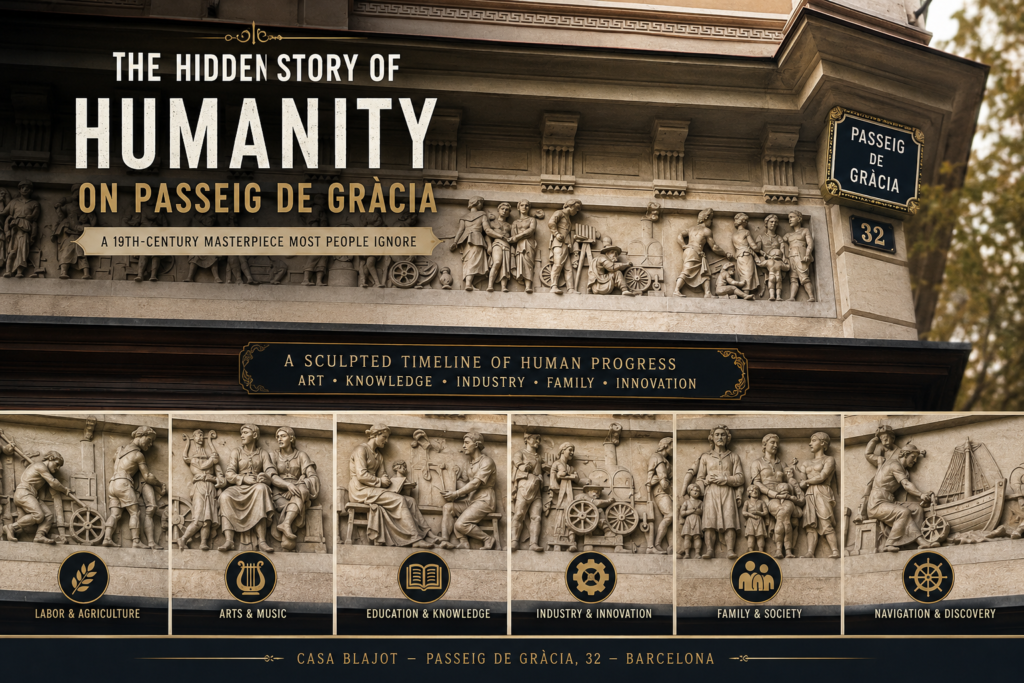
Right on the corner of Passeig de Gràcia and Carrer de Diputació, above a fashion store, there’s a sculpted frieze that quietly tells a much bigger story:
👉 the story of human progress, carved in stone.
A Hidden Detail in the Heart of Barcelona
The building is known as Casa Blajot, a 19th-century structure that most people walk past without a second thought.
Overshadowed by landmarks like Casa Batlló or La Pedrera, it doesn’t scream for attention.
But just above the storefronts, stretching across the façade, there’s a long sculptural relief that completely transforms how you see the building — and the city itself.
Barcelona, 1888: A City Obsessed with Progress
To understand this frieze, you need to step back into one key moment:
Barcelona in the late 19th century.
This was the era of the 1888 Universal Exposition, when the city was actively reinventing itself as:
- modern
- industrial
- cultured
- internationally relevant
The same mindset that drove the transformation of the city for the Expo also shaped its architecture.
Buildings were no longer just functional — they became statements.
👉 If you want to understand this moment better, check out our full post on the Barcelona 1888 Universal Exposition.
And this frieze?
It’s a perfect reflection of that mentality.
A Stone “Timeline” of Human Progress
If you take a moment to actually follow the relief from one side to the other, something remarkable happens:
You start to recognize scenes, not random decoration, but a structured narrative.
👉 It reads almost like a stone comic strip of civilization.
Among the figures, you can identify:
🔧 Craftsmanship and manual labor — people shaping materials, building, creating
📚 Education and knowledge — teaching, reading, intellectual activity
👨👩👧 Daily life and family — human relationships and continuity
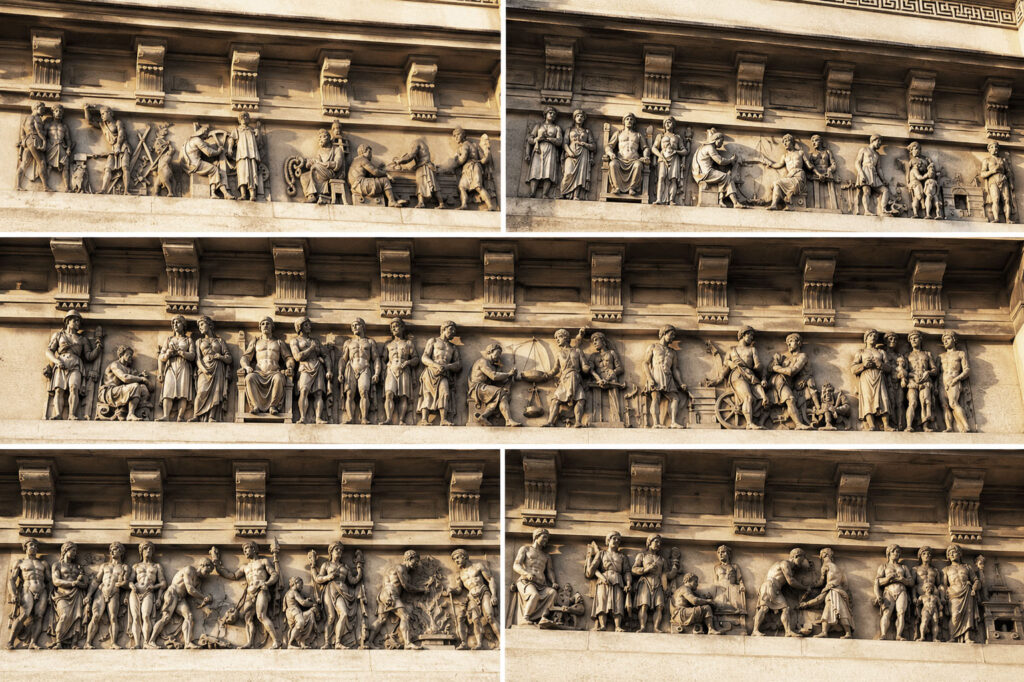
What makes it unique is the mix of influences.
You’ll see figures that feel:
- classical (almost Greco-Roman),
- medieval,
- and distinctly 19th-century industrial.
It’s not a snapshot; it’s a compressed vision of history moving forward.
A Message Hidden in Plain Sight
This kind of visual storytelling wasn’t accidental.
In late 19th-century Barcelona, the rising bourgeoisie used architecture to communicate ideas:
- progress
- knowledge
- civilization
- cultural identity
This frieze is essentially a manifesto carved into the building.
👉 A declaration that Barcelona saw itself as part of the great narrative of human advancement.
The Fragmented Story
Look closely, and you’ll notice something else.
The frieze doesn’t feel entirely continuous.
Some sections seem cut or interrupted — most likely due to later commercial renovations of the ground floor.
Which means:
👉 Part of this “history of humanity” may have been lost… to make space for shop windows.
A small but telling detail about how cities evolve — and what they choose to preserve.
The Real Lesson: Look Up
This is exactly the kind of detail we focus on at Barcelona Retro Tours.
Because the city isn’t just at eye level.
👉 Barcelona is written above you:
- in cornices
- in balconies
- in forgotten sculptures
- in details designed to be discovered, not advertised
And this frieze is one of the best examples.
Thousands of people walk past it every day…
without ever realizing they’re looking at a 19th-century vision of human history.
Final Thought
Next time you’re on Passeig de Gràcia, don’t just look at the brands.
Look up.
You might just find that Barcelona is telling you a story —
one that’s been there all along.